
Welcome to the archives of St. Peter’s Parish! Our history dates back to 1978.
Select any image for a closer look.

New Parish Proposal Receives Opposition
Archive no. : 005
A plan by Most Rev. Eugene LaRocque to end the bilingual nature of Holy Cross Church and to create a new parish for English-speaking Roman Catholics in Cornwall’s east end has run into stiff opposition from a number of English and French-speaking parishioners. A group of mostly anglophone parishioners have this week been circulating a petition urging the bishop to reconsider the proposed changes that are to take effect Labour Day
weekend.
Petition organizers (they wish to remain anonymous) say that about 80 per cent of those approached to date have agreed to sign the petition that is being circulated in both languages. Unconfirmed reports suggest that about 700 persons have signed so far. The parish includes about 1,500 families, two thirds of whom are predominantly French- speaking. The petition surfaced Sunday. Organizers canvassed part of the parish and the petition was presented to those entering the church for Mass. Bishop LaRocque learned of the petition Sunday and referred the issue to Rev. Bernard Guindon, vicar-general of the diocese.
The bishop has been attending a conference in New Orleans this week and will return on Saturday. Organizers are hopeful of meeting with him on the weekend and will circulate the petition until Saturday. Father Guindon could not be reached for comment.
The plan announced by the bishop two weeks ago would make Holy Cross a unilingual French Church. A new English parish that would include anglophone catholics east of McConnell Avenue would be created.
Mass would be celebrated at the St. Lawrence High School auditorium and the priest, Rev. Kelvin Maloney, would live in a rented house at 407 Anthony St. – FUEL FRICTION –
The petition charges that the bishop’s plan would serve to fuel the growing friction between French and English speaking residents of Cornwall. “The rivalry between French and English speaking people seems to be increasing rapidly in the community,” it says. “We feel the church has a role to play in this matter by encouraging all Christians to work together.”
The petition points out that many families in the parish have one anglophone and one francophone parent and that those parents want to attend the same church.
It also suggests that “several parishioners” are so bitter of the Bishop’s decision that they no longer attend mass at all. Others are refusing to attend Holy Cross and say they won’t attend mass at the high school auditorium.
“We feel that the majority of English and French speaking people in the parish are very proud of being able to operate in an atmosphere of bilingualism,” the petition states. “We are told that we will no longer be able to do so.”
– DIFFICULTIES –
“We realize that the operation of a bilingual parish the parish priests,” the petition creates many difficulties for adds. “However, we are under the impression that the church was built for the people, not the priests. Knowing that problems exist, we feel parishioners have in the past and will in the future assist the priests as much as possible.”
The petition also suggests that the church can accommodate even more parishioners because it has a number of empty pews. And it points out that if the changes take place, anglophone founders of the parish won’t be able to attend Mass at the church.
The petition also charges that the bishop announced the changes without consulting the council or the parish parishioners. A news release which announced the change two weeks ago said the bishop was acting on the advice of the diocesan consultors and after consulting the pastoral council and parishioners of Holy Cross.”
– ATTENDED MASSES –
But some behind the protest movement say they first learned of the plan three weeks ago when Bishop LaRocque attended all six weekend masses to explain the change. The bishop invited public input at the time but one parishioner said today the proposal was presented as a “fait accompli.”
The following Sunday, Father Maloney, who celebrates the two weekend English masses at the church (four weekend masses are in French) told parishioners he was surprised by the degree of opposition to the plan.
Ron McCabe, president of the Holy Cross Parish Council, said the council has taken no position on the controversy. Mr. McCabe added that the idea of unilingual parishes was first raised in 1973 at a Synod held in the diocese. One of the Synod’s recommendations was that all new parishes should be unilingual.
Mr. McCabe said the bishop’s plan is supported by both Father Maloney and Rev. Rheal Bisaillon who handles French services at Holy Cross. He said the priests feel that parishes smaller would enhance personal contact with parishioners.
Mr. McCabe added that not all English-speaking Catholics in the church area are happy with the bilingual nature of Holy Cross. He said “quite a few” attend St. Columban’s – the nearest Catholic church offering mass in English.

New Parish for East Cornwall
Archive no. : 004
Wednesday, August 2, 1978 – Acting on advice of the Diocesan Consultors and after consulting the Pastoral Council and parishioners of Holy Cross, Most Rev. Eugene LaRocque, bishop of Alexandria-Cornwall Diocese, has formed a new parish in east Cornwall for English-speaking Roman Catholics.
Rev. Kelvin Maloney has been named pastor. Bishop LaRocque said parishioners will be involved in choosing a name for the Parish.
Beginning Labour Day weekend, Mass will be celebrated at St. Lawrence High School auditorium on Saturday evening and Sunday morning. Father Maloney will live in a rented house at 407 Anderson Dr. Bishop LaRocque said there are no immediate plans for building a church or rectory.
Holy Cross serves more than 1,000 French-speaking families with Rev. Rheal Bisaillon as pastor and Rev. Roger Tremblay, formerly of St. Francis de Sales, as associate pastor.
Rev. Gilles Ayotte is being given a year to further his studies at the Dominican Pastoral Institute in Montréal.
Other appointments announced by Bishop LaRocque were: Rev. Gordon Bryan, Deacon, will assist Rev. George Maloney, pastor of St. Francis de Sales and continue as director of the diocesan centre.
Sister Jeanne Goulet, C.S.C., will assist Rev. Rejean Lebrun, pastor of St. John Bosco parish. Rev. Gilles Deslauriers will reside at the rectory and provide weekend assistance. He is named pastoral animator at La Citadelle High School and is responsible for the apostolate to youth among the francophones.
Rev. Charles MacDonald and Rev. Kevin Maloney are co-responsible for youth among the anglophones.
Rev. Norman Loney is named director of the deacon formation program for the diocese. Rev. Gordon Bryan will act as coordinator.
Rev. Maurice Lalonde, C.S.V., will be chaplain of Bestview Manor, assisted by Sister Eileen Byrnes of the Hospitallers of St. Joseph.
Rev. Columba McManus, O.S.M., of the Servants of Mary Fathers will be chaplain in residence at St. Joseph’s Villa, Cornwall.
Rev. Denis Vaillancourt will spend a second year in the study of Church law at St. Paul’s University, Ottawa.
Upon the advice of the Diocese Consultors and after consulting the Pastoral Council and the parishioners of Holy Cross parish, as Bishop of the diocese I hereby form a new parish in east Cornwall for English speaking faithful under the leadership of Rev. Kelvin Maloney, Pastor. Parishioners of the new parish will be involved in choosing a name for the new parish.
Beginning on Labour Day weekend Sunday Mass will be celebrated at St. Lawrence High School auditorium on Saturday evening and The Sunday morning. Pastor will live in a rented home at 407 Anderson Drive, Cornwall.
There are no plans for building a church or rectory at the present time.
Holy Cross parish will continue serving over 1000 French speaking families with Fr. Rheal Bisaillon as Pastor and Fr. Roger Tremblay (formerly of St. Francis de Sales) as associate Pastor. Fr. Gilles Ayotte is being given a year of absence to further his studies at the Dominican Pastoral Institute in Montreal.

Bishop Issues Warning in School Property Bid
Archive no. : 006
Can the SD&G separate school system afford to forfeit $20,900 in order to avoid a conflict with Most Rev. Eugene LaRocque, bishop of Alexandria-Cornwall?
That’s the sensitive question trustees on the school board will have to tackle in the near future. Late last month the board called public tenders for the sale of the old Notre Dame des Anges school in Moose Creek. Three bids were received and opened Tuesday afternoon. The highest bid by far was submitted by Gerard Theoret of Moose Creek. Mr. Theoret said he was prepared to pay $26,000 for the building and surrounding land. He proposed to convert the school into a centre to accommodate a doctor, a dentist and a hairdresser. A bid of $12,578 was submitted by Louis Bray Construction Ltd. of Green Valley. And the Roman Catholic diocese of Alexandria-Cornwall, under the signature of Bishop LaRocque, submitted a bid of $5,100. The bishop’s bid explained that the site would be used primarily for a parking facility for the adjoining parish church. It could also serve for the possible enlargement of the cemetery. But the bishop added a separate sheet on which he enumerated six reasons why his low bid should be accepted by the board.
– REASONS GIVEN –
His letter points out that the land was sold by the parish to the school board in 1957 for $1,000. Bishop LaRocque also stressed that the parishioners and school supporters are the same people and suggested that the building belongs to the people of Moose Creek because the school was built before creation of the regional school board.
“If the lands are sold to a private individual or firm,” the letter adds, “the parish church parking will be reduced and curtailed to almost nothing.”
Bishop LaRocque’s letter also warns the board to be prepared for an adverse reaction if the school is sold to a party other than the diocese.
would be placed in a reserve the board could ill afford to fund to be spent on future capital projects.
“If the sale is to the low bidder,” Mr. Cooper said, “The board will forfeit $21,000 that will have to be raised through taxes at a future date.”
But a number of trustees appeared hesitant to challenge the bishop.
Trustee Art Daigneault pointed out that the board has sold schools for very little in the past. “Before we start selling it to a stranger, we should consider the bishop’s offer,” he said. “We’ve almost given schools away in the past and this is the icing on the cake.”
Trustee Terrence Wheeler mentioned a similar precedent. He said an old school in Williamstown was once sold to a community group for $3,000 when the high bid was $10,000. “It may sound like a strange thing to lose $21,000,” Trustee Wheeler said. “But we should look at this as making $5,100.” A few trustees suggested that pass up the high offer. But they were quickly accused by trustee Daigneault of being poor Christians.
“Christianity sure goes by the wayside when the dollar comes up, Mr. Daigneault said. He added that the board would be doing Mr. Theoret a favor by not selling him the school for $26,000. “He’d be losing his shirt,” he explained.
Director of Education Charlemagne Lamarche suggested the board find a way “not to hurt the board financially and to satisfy the bishop’ at the same time. Trustees eventually voted in favor of a suggestion by Ron Bergeron that both parties be approached to determine if a solution could be found.
“One needs the land and the other needs the building,” Trustee Bergeron said. “I’m sure the board could gain by attempting to answer to each need.”
Bishop LaRocque founds St. Peter’s
Archive no. : 003
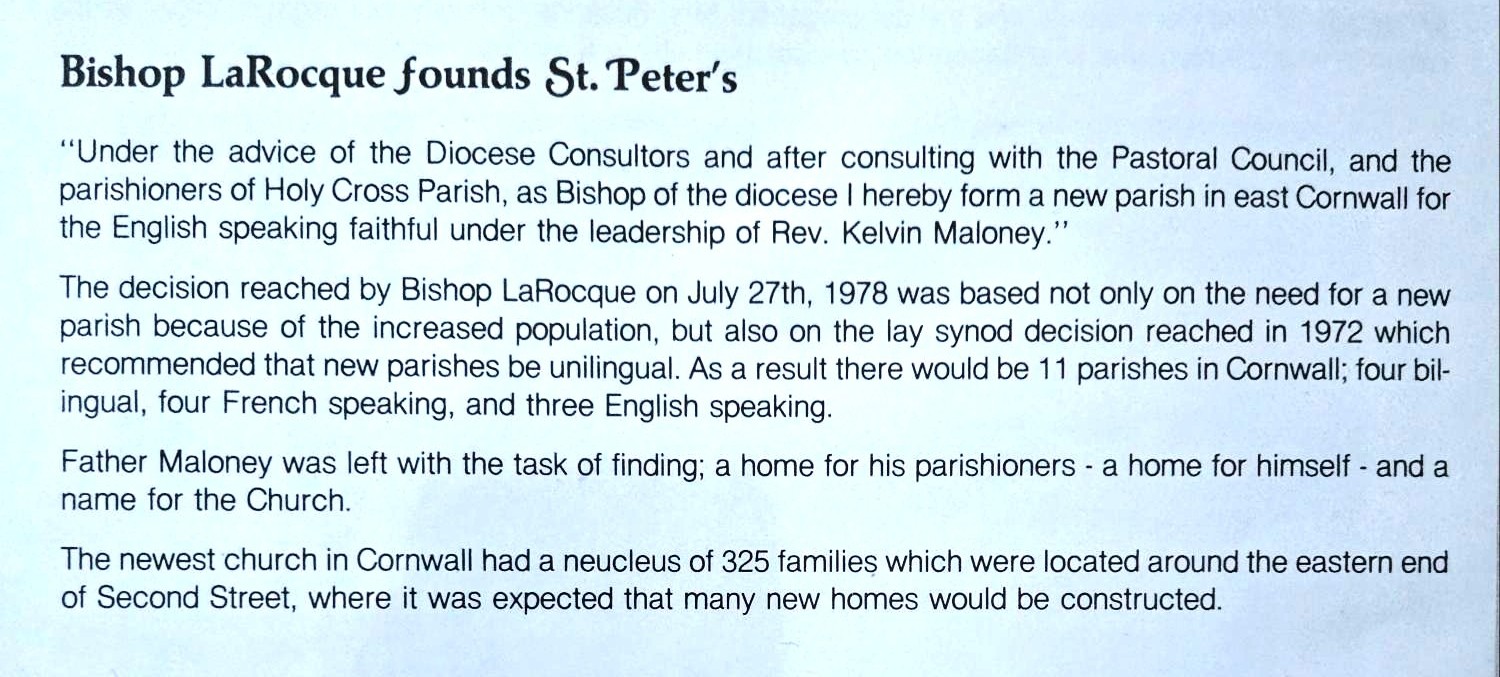
“Under the advice of the Diocese Consultors and after consulting with the Pastoral Council, and the parishioners of Holy Cross Parish, as Bishop of the diocese I hereby form a new parish in east Cornwall for the English speaking faithful under the leadership of Rev. Kelvin Maloney.”
The decision reached by Bishop LaRocque on July 27th, 1978 was based not only on the need for a new parish because of the increased population, but also on the lay synod decision reached in 1972 which recommended that new parishes be unilingual. As a result there would be 11 parishes in Cornwall; four bilingual, four French speaking, and three English speaking.
Father Maloney was left with the task of finding; a home for his parishioners – a home for himself – and a name for the Church.
The newest church in Cornwall had a nucleus of 325 families which were located around the eastern end of Second Street, where it was expected that many new homes would be constructed.

Holy Cross Plans Remain Unchanged
Archive no. : 007
A spokesman for Most Rev. Bishop Eugene LaRocque said today that plans to make Holy Cross church a unilingual French church remain unchanged.
Rev. Bernard Guindon, vicar-general for Cornwall-Alexandria diocese, said that objections to the proposal from some Holy Cross parishioners will not alter the changes that are to take effect Labor Day weekend.
Bishop LaRocque announced three weeks ago that a new parish for English-speaking Catholics in the city’s east end would be created. Services for the new parish will be held in the auditorium of St. Lawrence High School.
But the plan was opposed by a number of parishioners who last week circulated a petition urging the bishop to reconsider. The petition charged that the change would serve only to increase the growing rivalry between French and English-speaking residents of the city. “We feel the church has a role to play in this matter by encouraging all Christians to work together,” it said.
The group which circulated the petition met with Bishop LaRocque on Saturday. But Father Guindon, who also attended the meeting, said the original proposal will go ahead.
“We respect the opinions of others,” he said, “but it is up to the bishop to decide. He made his decision after much consideration and I don’t think a petition changed anything.”
Father Guindon added that. those objecting to the change misunderstood its purpose.
“They are taking this from the wrong point of view. It’s not a plan to divide French and English. We’re just proceeding with the recommendations of the synod five years ago.”
He said the new parish would serve not only Anglophones from Holy Cross but Anglophones east of McConnell Avenue. He said some now attend St. Felix, others Holy Cross or Nativity. “Those opposing the change are over-reacting,” said Father Guindon. “It’s not a language issue.”
Group Wants Bishop Overruled
Archive no. : 009
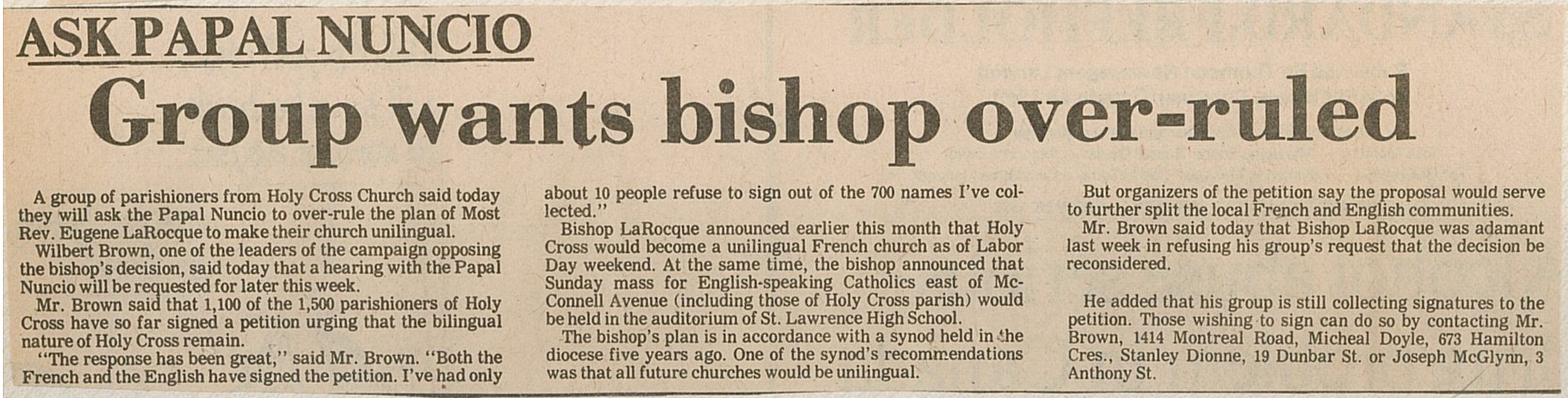
A group of parishioners from Holy Cross Church said today they will ask the Papal Nuncio to over-rule the plan of Most Rev. Eugene LaRocque to make their church unilingual.
Wilbert Brown, one of the leaders of the campaign opposing the bishop’s decision, said today that a hearing with the Papal Nuncio will be requested for later this week.
Mr. Brown said that 1,100 of the 1,500 parishioners of Holy Cross have so far signed a petition urging that the bilingual nature of Holy Cross remain.
“The response has been great,” said Mr. Brown. “Both the French and the English have signed the petition. I’ve had only about 10 people refuse to sign out of the 700 names I’ve collected.”
Bishop LaRocque announced earlier this month that Holy Cross would become a unilingual French church as of Labor Day weekend. At the same time, the bishop announced that Sunday mass for English-speaking Catholics east of Mc- Connell Avenue (including those of Holy Cross parish) would be held in the auditorium of St. Lawrence High School.
The bishop’s plan is in accordance with a synod held in the diocese five years ago. One of the synod’s recommendations was that all future churches would be unilingual.
But organizers of the petition say the proposal would serve to further split the local French and English communities. Mr. Brown said today that Bishop LaRocque was adamant last week in refusing his group’s request that the decision be reconsidered.
He added that his group is still collecting signatures to the petition. Those wishing to sign can do so by contacting Mr. Brown, 1414 Montreal Road, Micheal Doyle, 673 Hamilton Cres., Stanley Dionne, 19 Dunbar St. or Joseph McGlynn, 3 Anthony St.
Change in Holy Cross Parish Retrograde Move
Archive no. : 008
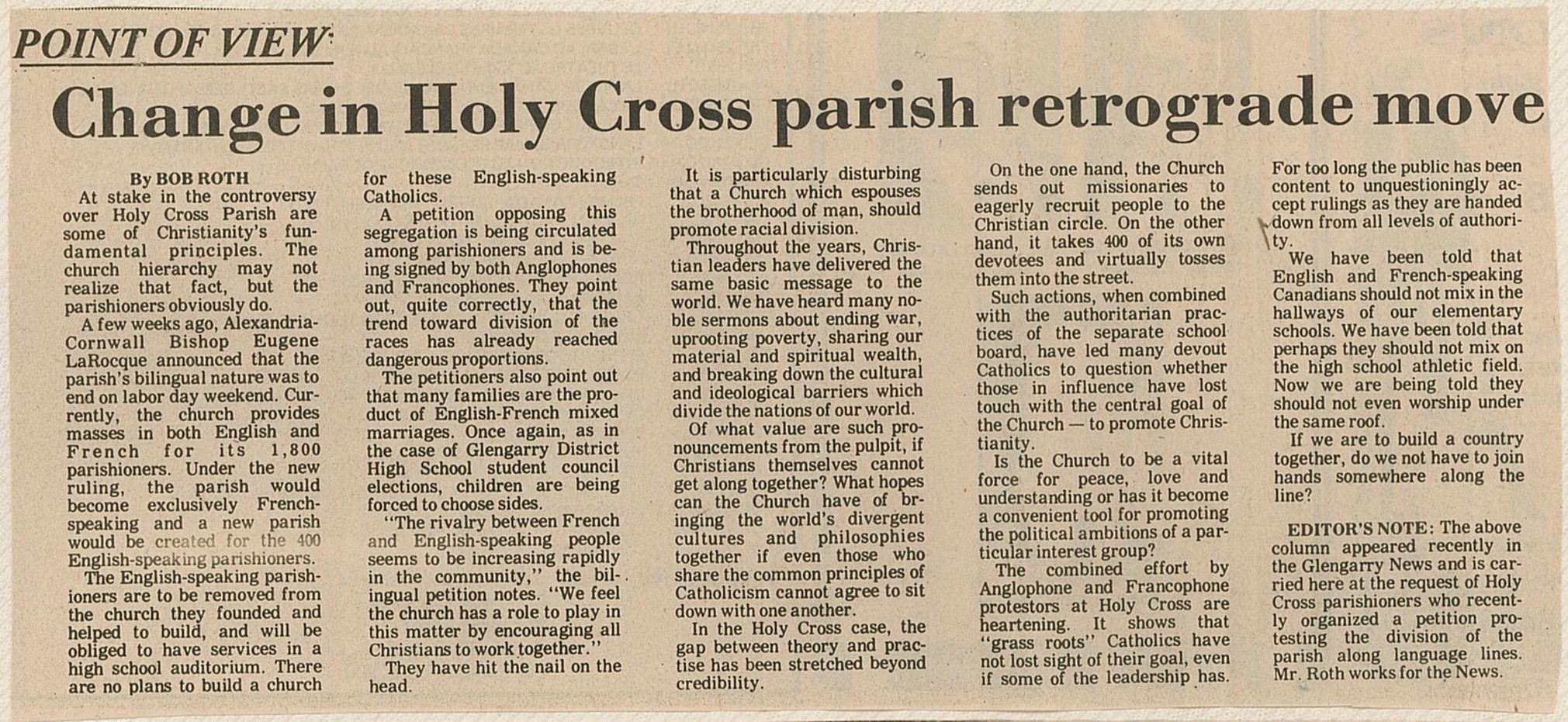
At stake in the controversy over Holy Cross Parish are some of Christianity’s fundamental principles. The church hierarchy may not realize that fact, but the parishioners obviously do. A few weeks ago, Alexandria-Cornwall Bishop Eugene LaRocque announced that the parish’s bilingual nature was to end on labor day weekend. Currently, the church provides masses in both English and French for its 1,800 parishioners. Under the new ruling, the parish would become exclusively French-speaking and a new parish would be created for the 400 English-speaking parishioners. The English-speaking parishioners are to be removed from the church they founded and helped to build, and will be obliged to have services in a high school auditorium. There are no plans to build a church for these English-speaking Catholics. A petition opposing this segregation is being circulated among parishioners and is being signed by both Anglophones and Francophones. They point out, quite correctly, that the trend toward division of the races has already reached dangerous proportions. The petitioners also point out that many families are the product of English-French mixed marriages. Once again, as in the case of Glengarry District High School student council elections, children are being forced to choose sides. “The rivalry between French and English-speaking people seems to be increasing rapidly in the community,” the bilingual petition notes. “We feel the church has a role to play in this matter by encouraging all Christians to work together.” They have hit the nail on the head. It is particularly disturbing that a Church which espouses the brotherhood of man, should promote racial division. Throughout the years, Christian leaders have delivered the same basic message to the world. We have heard many noble sermons about ending war, uprooting poverty, sharing our material and spiritual wealth, and breaking down the cultural and ideological barriers which divide the nations of our world. Of what value are such pronouncements from the pulpit, if Christians themselves cannot get along together? What hopes can the Church have of bringing the world’s divergent cultures and philosophies together if even those who share the common principles of Catholicism cannot agree to sit down with one another. In the Holy Cross case, the gap between theory and practice has been stretched beyond credibility. On the one hand, the Church sends out missionaries to eagerly recruit people to the Christian circle. On the other hand, it takes 400 of its own devotees and virtually tosses them into the street. Such actions, when combined with the authoritarian practices of the separate school board, have led many devout Catholics to question whether those in influence have lost touch with the central goal of the Church to promote Christianity. Is the Church to be a vital force for peace, love and understanding or has it become a convenient tool for promoting the political ambitions of a particular interest group? The combined effort by Anglophone and Francophone protestors at Holy Cross are that heartening. It shows “grass roots” Catholics have not lost sight of their goal, even if some of the leadership has. For too long the public has been content to unquestioningly accept rulings as they are handed down from all levels of authority. We have been told that English and French-speaking Canadians should not mix in the hallways of our elementary schools. We have been told that perhaps they should not mix on the high school athletic field. Now we are being told they should not even worship under the same roof. If we are to build a country together, do we not have to join hands somewhere along the line?
EDITOR’S NOTE: The above column appeared recently in the Glengarry News and is carried here at the request of Holy Cross parishioners who recently organized a petition protesting the division of the parish along language lines. Mr. Roth works for the News.
Meeting with Envoy Awaited
Archive no. : 010
Meeting with envoy awaited
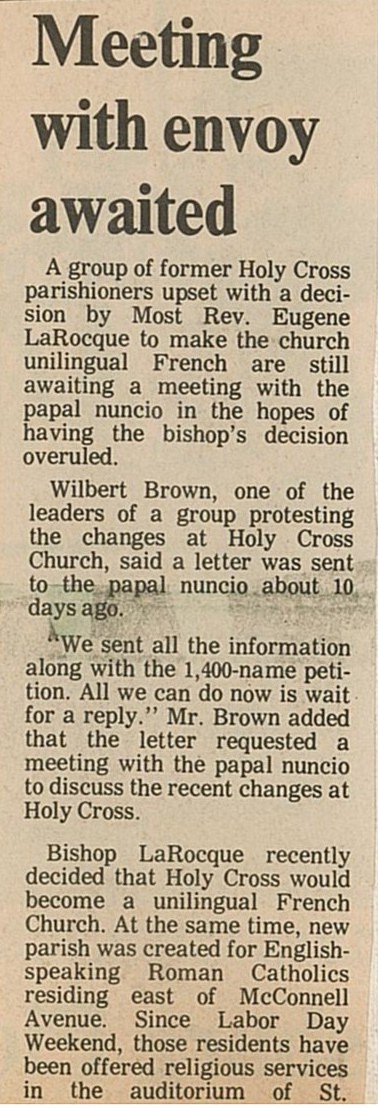
A group of former Holy Cross parishioners upset with a decision by Most Rev. Eugene LaRocque to make the church unilingual French are still awaiting a meeting with the papal nuncio in the hopes of having the bishop’s decision overruled.
Wilbert Brown, one of the leaders of a group protesting the changes at Holy Cross Church, said a letter was sent to the papal nuncio about 10 days ago.
“We sent all the information along with the 1,400-name petition. All we can do now is wait for a reply.” Mr. Brown added that the letter requested a meeting with the papal nuncio to discuss the recent changes at Holy Cross.
Bishop LaRocque recently decided that Holy Cross would become a unilingual French Church. At the same time, new parish was created for English-speaking Roman Catholics residing east of McConnell Avenue. Since Labour Day Weekend, those residents have been offered religious services the auditorium of St. Lawrence High School.
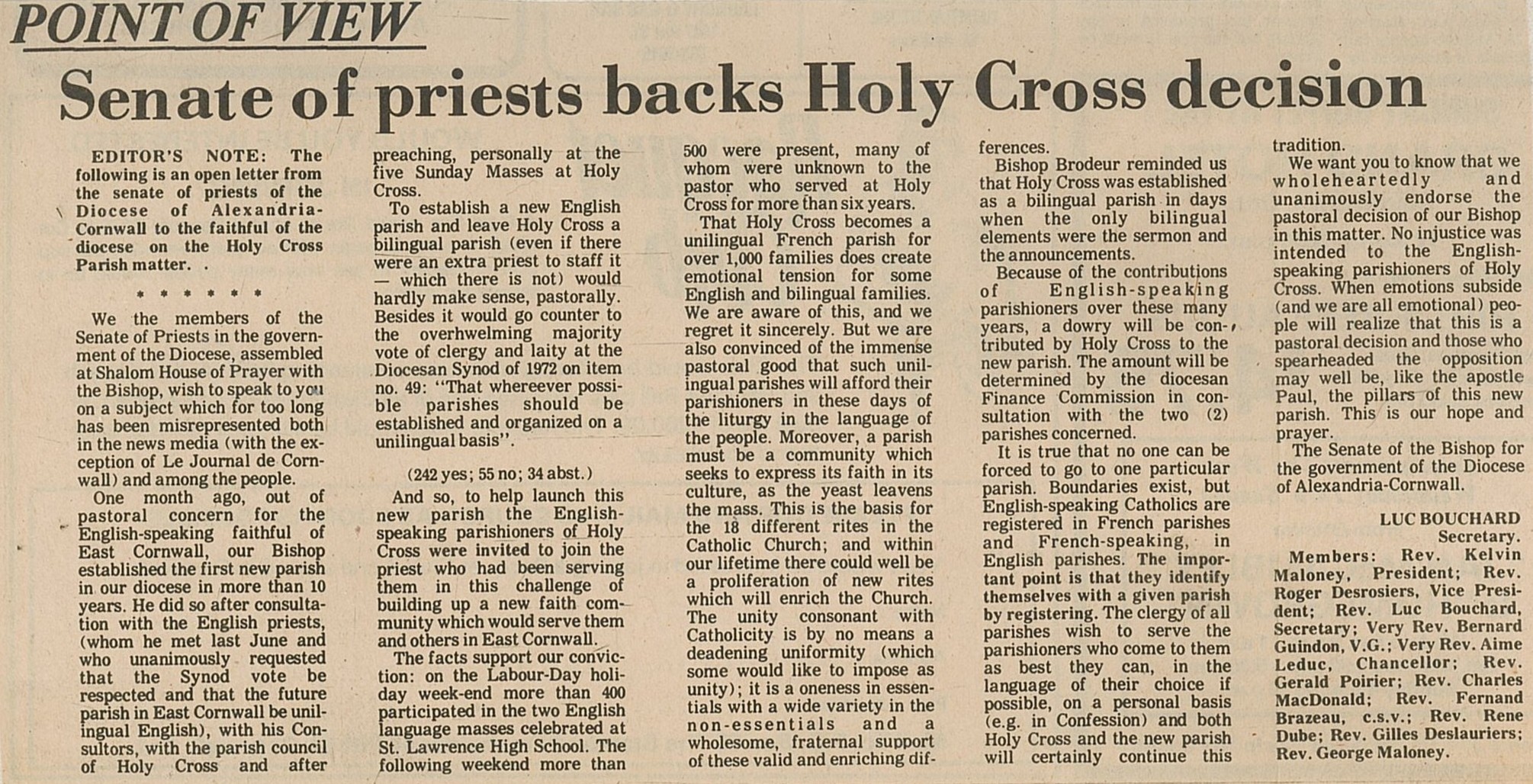
Senate of Priests Backs Holy Cross Decision
Archive no. : 011
Editor’s note: The following is an open letter from the senate of priests of the Diocese of Alexandria-Cornwall to the faithful of the diocese on the Holy Cross Parish matter.
We the members of the Senate of Priests in the government of the Diocese, assembled at Shalom House of Prayer with the Bishop, wish to speak to you on a subject which for too long has been misrepresented both in the news media (with the exception of Le Journal de Cornwall) and among the people. One month ago, out of pastoral concern for the English-speaking faithful of East Cornwall, our Bishop established the first new parish in our diocese in more than 10 years. He did so after consultation with the English priests, (whom he met last June and who unanimously requested that the Synod vote be respected and that the future parish in East Cornwall be unilingual English), with his Consultors, with the parish council after of Holy Cross and preaching, personally at the five Sunday Masses at Holy Cross.
To establish a new English parish and leave Holy Cross a bilingual parish (even if there were an extra priest to staff it – which there is not) would hardly make sense, pastorally. Besides it would go counter to the overwhelming majority vote of clergy and laity at the Diocesan Synod of 1972 on item no. 49: “That wherever possible parishes should be established and organized on a unilingual basis”
(242 yes; 55 no; 34 abst.) And so, to help launch this new parish the English- speaking parishioners of Holy Cross were invited to join the priest who had been serving them in this challenge of building up a new faith com- munity which would serve them and others in East Cornwall.
The facts support our conviction: on the Labour Day holiday week-end more than 400 participated in the two English language masses celebrated at St. Lawrence High School. The following weekend more than 500 were present, many of whom were unknown to the pastor who served at Holy Cross for more than six years.
That Holy Cross becomes a unilingual French parish for over 1,000 families does create emotional tension for some English and bilingual families. We are aware of this, and we regret it sincerely. But we are also convinced of the immense pastoral good that such unilingual parishes will afford their parishioners in these days of the liturgy in the language of the people. Moreover, a parish must be a community which seeks to express its faith in its culture, as the yeast leavens the mass. This is the basis for the 18 different rites in the Catholic Church; and within our lifetime there could well be a proliferation of new rites which will enrich the Church. The unity consonant Catholicity is by no means a deadening uniformity (which some would like to impose as unity); it is a oneness in essentials with a wide variety and wholesome, fraternal support of these valid and enriching differences.
Bishop Brodeur reminded us that Holy Cross was established as a bilingual parish in days when the only bilingual elements were the sermon and the announcements. Because of the contributions of English-speaking parishioners over these many years, a dowry will be contributed by Holy Cross to the new parish. The amount will be determined by the diocesan Finance Commission in consultation with the two (2) parishes concerned.
It is true that no one can be forced to go to one particular parish. Boundaries exist, but English-speaking Catholics are registered in French parishes and French-speaking, in English parishes. The important point is that they identify themselves with a given parish by registering. The clergy of all parishes wish to serve the parishioners who come to them as best they can, in the language of their choice if possible, on a personal basis (e.g. in Confession) and both Holy Cross and the new parish will certainly continue this tradition.
We want you to know that we wholeheartedly and unanimously endorse the pastoral decision of our Bishop in this matter. No injustice was intended to the English- speaking parishioners of Holy Cross. When emotions subside (and we are all emotional) people will realize that this is a pastoral decision and those who spearheaded the opposition may well be, like the apostle Paul, the pillars of this new parish. This is our hope and prayer. The Senate of the Bishop for the government of the Diocese of Alexandria-Cornwall.
Luc Bouchard, Secretary.
Members: Rev. Kelvin Maloney, President; Rev. Roger Desrosiers, Vice President; Rev. Luc Bouchard, Secretary; Very Rev. Bernard Guindon, V.G.; Very Rev. Aime Leduc, Chancellor; Rev. Gerald Poirier; Rev. Charles MacDonald; Rev. Fernand Brazeau, c.s.v.; Rev. Rene Dube; Rev. Gilles Deslauriers; Rev. George Maloney.
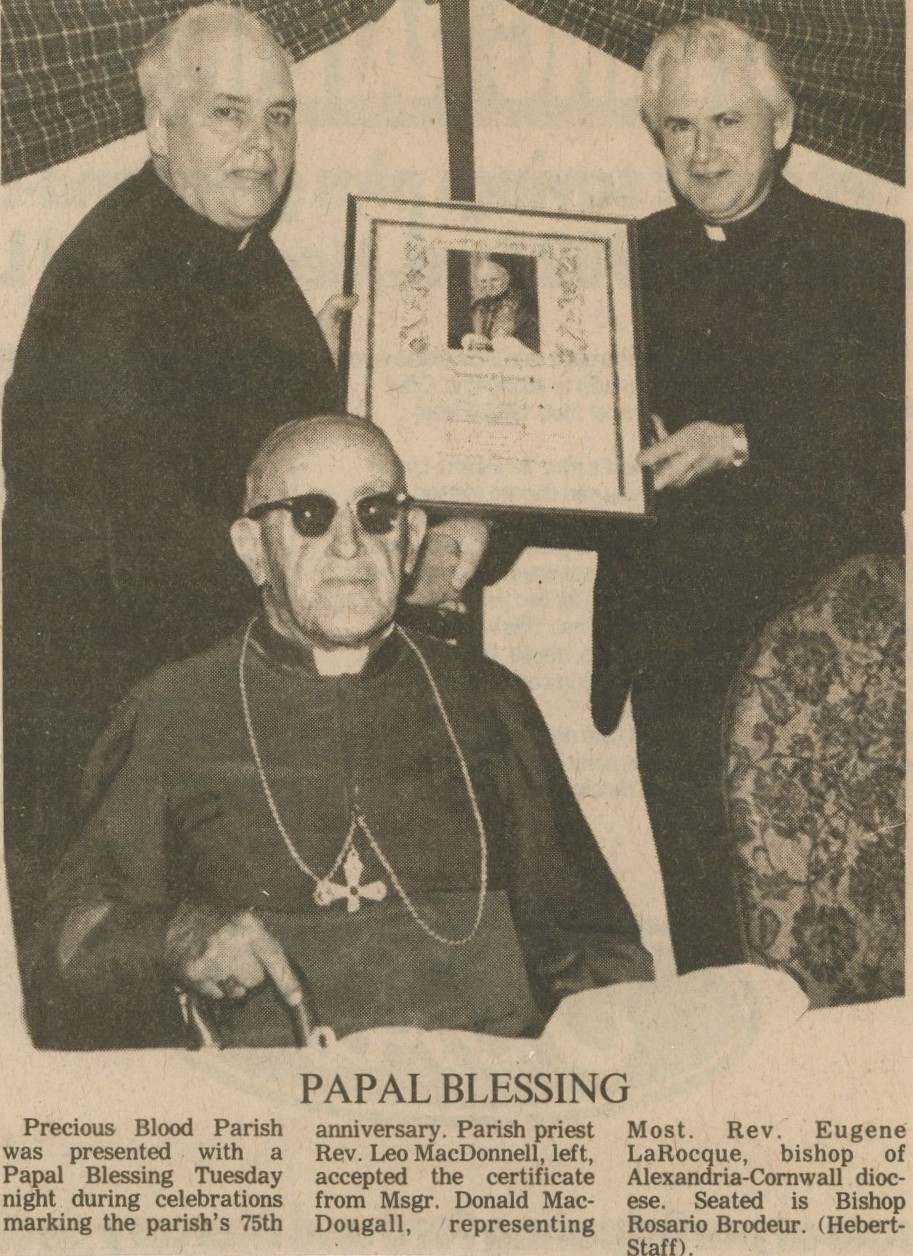
Papal Blessing
Archive no. : 002
Precious Blood Parish was presented with a Papal Blessing Tuesday night during celebrations marking the Parish’s 75th anniversary. Parish priest Rev. Leo MacDonnell, left, accepted the certificate from Msgr. Donald MacDougall, representing Most. Rev. Eugene LaRocque, bishop of Alexandria-Cornwall diocese. Seated is Bishop Rosario Brodeur.
Archive no. : 001